
Claudia Satzke, a College of Medicine student, was awarded a Center for Global Health Student & Trainee Travel Grant to pursue a global health project in Ethiopia. Continue reading to learn more about the experience abroad. Click here to view more photos on Flickr.
I am so grateful for my past month in Soddo, Ethiopia. I had the opportunity to complete a 4-week rotation at Soddo Christian Hospital with mentors Drs. Nate and Cheryl Ross. During my time, I rotated through the orthopedic surgery, general surgery, pediatric, and OB/GYN services.
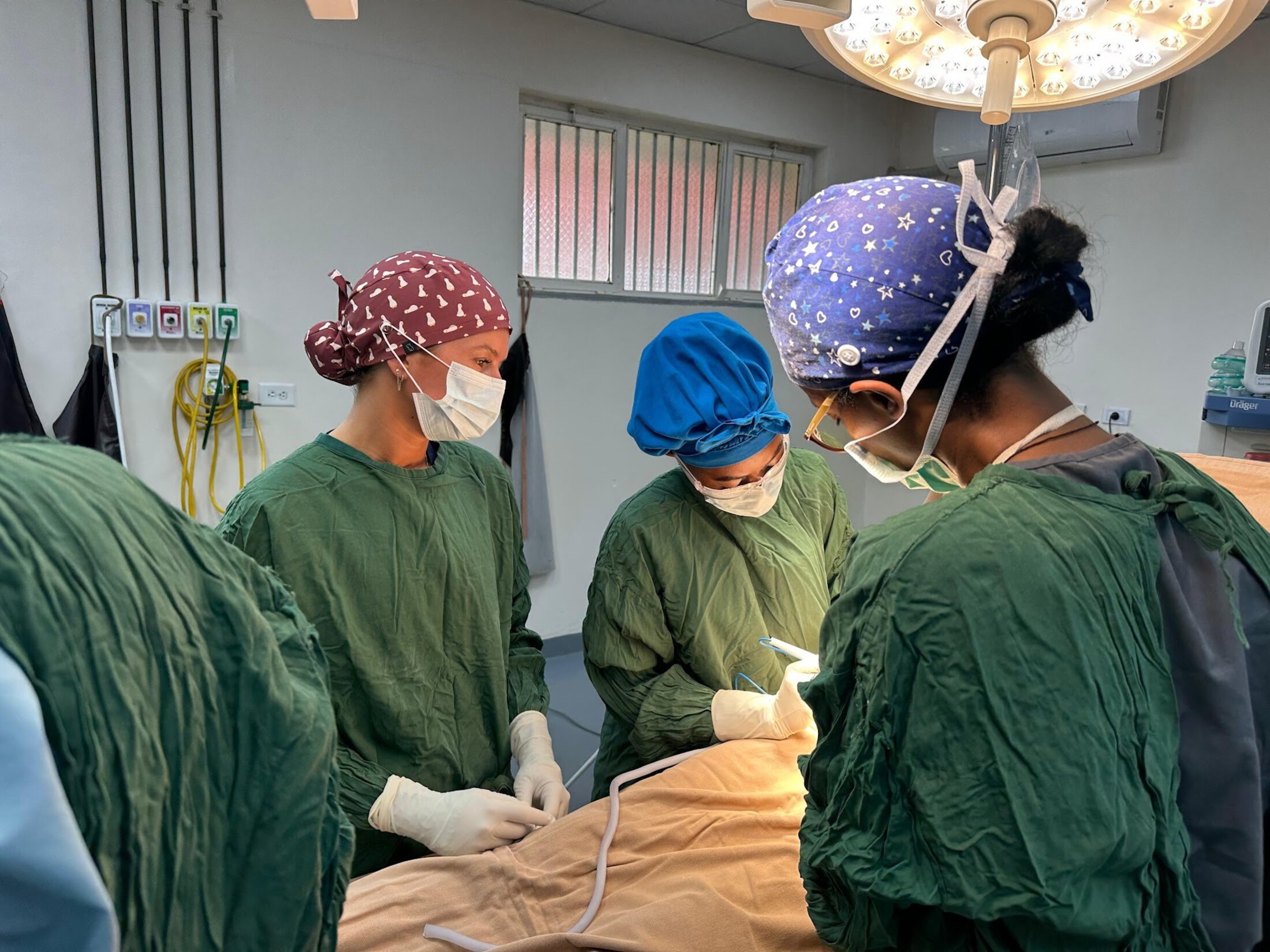
Each morning, we would round with our respective team. The residents would report on any overnight changes and updates on the patients. My favorite part of rounding was being able to become familiar with patients and then seeing their journey to recovery and ultimately discharge. I also loved how the medical teams would always ask to pray with the patients, a simple ask which had the biggest effect on the patients. If we were on a surgical team, we would then head over to the operating room. Not of course without some morning buna, the traditional Ethiopian coffee served at the hospital cafe. In Ethiopia, coffee and meals are deeply important. Food and drink are meant to be shared with others, to be a time of connection with others.
I quickly adopted this practice, looking forward to all the conversations to be had over injera and coffee. One morning, I learned that medical students in Ethiopia use the same third-party resources we do in the US to learn microbiology, which made all of us laugh hysterically.
The knowledge I learned at Soddo Christian Hospital is invaluable. I saw pathologies and observed surgical techniques I had never seen before. While I am innately fascinated by medicine and the basic science of it all, what struck me most was the people- doctors, nurses, and patients alike. Three words stuck out to me throughout the entire experience: adaptability, humility, and compassion.
Something we heard a lot prior to leaving for Ethiopia was that in global health, you must be adaptable. Instructors informed us that “the way we learn how to do things in the classroom” was not always applicable in a low- and middle- income country. While I knew this to be true, I did not realize to what extent. On my orthopedic surgery rotation, there was an intramedullary nail for a femur fracture scheduled that day. I had seen this surgery many times this week but today was for a 13-year-old female patient. During the operation, the surgeons quickly realized that the nails they had would be too large for this patient, causing more damage than benefit. I was left frustrated, confused, and helpless. I thought, if there was no nail, what could we possibly do now? If only we were at MUSC, then we could have the right size! To my dismay, the surgeons were unfazed and proceeded to call the repair workshop on the hospital base. The metal workers reassured the surgeons that they could forge a nail with the proper diameter and have it autoclaved to ensure sterility. After some time had passed, a scrub technician entered the OR with the new, autoclaved nail, perfectly formed for our patient. The nail was placed with ease, and the patient was walking the very next day!
A dear quote of mine is “humility is not thinking less of yourself, it's thinking of yourself less” by C.S. Lewis. I try to embody this quote daily; however it can be difficult when I am exhausted from a long day or upset about getting a question wrong. I can say with much confidence that everyone at Soddo Christian Hospital truly embodies this quote. On my general surgery rotation, I realized that general surgery really means general surgery. They operate in the thorax, abdomen, and pelvis, doing surgeries ranging from thyroidectomies to limb amputations to melanoma excision with subsequent flap repair. I constantly told the surgeons how amazed I was by their expertise and skill level, to which they never boasted. They were proud of their surgical knowledge but more so what they could do for their patients and quality of life. Patients themselves were also greatly humble. Even in their suffering from ailments, they were grateful for their life, the care they were receiving, and their loved ones who never left their side. There, medicine isn’t seen as a transaction or a work of science, but rather a miracle of humanity, to restore quality back to patient’s lives so they can do the things they love.
Compassion for others is engrained into the Ethiopian people and especially Soddo Christian Hospital. Whether it was genuine greetings to everyone you passed, conversations about your family back home, or spending extra time with dispirited patients, compassion radiated throughout the halls. While on my OBGYN rotation, we saw a young woman with a rectouterine fistula. Our doctors knew there was a clinic in the capital, Addis Ababa, that specializes in treating this condition. The woman was visibly upset; she had no means of getting to the capital and her condition was causing significant distress in her life. Without hesitation, one of the expatriate doctors left the clinic to go to his house. Upon returning, he quietly gave the patient the money needed for transport and stay in Addis Ababa. I was deeply moved by this act of compassion, a true demonstration of deep empathy, kindness, and a desire to alleviate the suffering of others.
The past month in Soddo simultaneously opened my eyes and reaffirmed my commitment to global health. It helped see my “why” for medicine so clearly and fueled my desire to become a physician that is adaptive, humble, adaptive, and compassionate in a contextually informed manner. I can only hope to emulate these qualities and lessons learned from Soddo as I continue my journey in medicine. Valuing and honoring humans and humanity doesn’t require the newest surgical tools, the fanciest computers, or biggest price tags, but rather a spirit of humility and the desire to serve.
Recent Center for Global Health stories