
In neonatal and congenital heart surgery, the repair is only part of the story. At MUSC Children’s Heart Center, a highly coordinated ICU model allows teams to make rapid decisions when complex patients change course.
For the smallest and sickest cardiac patients, the operation is rarely the whole story. What happens in the hours that follow can be just as consequential. A newborn may leave the operating room with an excellent repair and still require minute-to-minute adjustments in support, imaging, ventilation, and organ management. In that setting, the even slightest delay matters.
At MUSC Children’s Heart Center, Dr. Minoo Kavarana says the program’s greatest strength is not a single procedure. It is the team built to respond when complex cases stop following the script.
“It takes a village to get any newborn baby or child out of the hospital alive in a good condition,” he says.
A different model of care
Children recovering from congenital heart surgery often present challenges far beyond the heart itself. They may be premature. They may be underweight. They may also be dealing with kidney dysfunction, lung issues, or the need for ECMO and other advanced support.
That complexity is why MUSC’s bedside model stands out.
Unlike many programs where cardiologists manage the heart and a separate ICU team manages the rest, MUSC’s pediatric cardiologists also function as intensivists. That means the same clinicians who understand the anatomy and repair are also at the bedside managing the child’s full physiologic picture.
For Kavarana, that continuity changes the speed and precision of care.
“If something is not going according to the flight plan that I envisioned, those questions have to be answered right away,” he says.
In practical terms, that can mean powering up an echo machine within minutes, evaluating a repair in real time, and determining whether the problem is surgical, hemodynamic, pulmonary, or something else entirely.
When minutes matter
That capability becomes especially important after the most complex operations, when a child’s condition can change rapidly.
At MUSC Health, Kavarana can come out of the operating room, speak directly with a cardiology colleague who understands the repair in detail, and know that same physician may still be overseeing the patient’s care hours later in the ICU.
That continuity is not just operationally efficient. It is clinically meaningful.
A bedside team that can interpret echo findings immediately, connect them to what happened in the operating room, and act without waiting for outside read-ins or delayed consults can shorten the path to the next decision.
“There are many centers around the country that have the cardiologist manage the heart, and then they have an intensive care team manage the rest of the organs,” Kavarana says. “Our team is unique in that they are specialists and they are masters at taking care of very sick newborn babies all the way up to young adults.”
More than one specialist at a time
That expertise extends beyond physicians.
The model depends on ICU nurses, respiratory therapists, perfusionists, and the broader care team being equally comfortable with advanced support. These are patients who may need dialysis, ECMO, complex ventilator adjustments, or other interventions layered on top of congenital heart recovery.
“There’s no end to the amount of support these children need,” Kavarana says. “It’s second to second, not just minute to minute.”
That level of coordination does not develop overnight. It depends on training, repetition, and a culture that centers each decision on the patient in front of the team.
Kavarana believes that culture is one of the program’s defining advantages.
“We as a group have a culture of providing what’s best for that particular patient at that particular time,” he says.
Why it matters to referring physicians
For physicians deciding where to send their most complex patients, the difference often comes down to coordination.
When surgery, ICU care, and subspecialty expertise are fully aligned, it changes what is possible for children whose conditions do not follow a standard path.
At MUSC Children’s Heart Center, that level of coordination is built into how care is delivered.
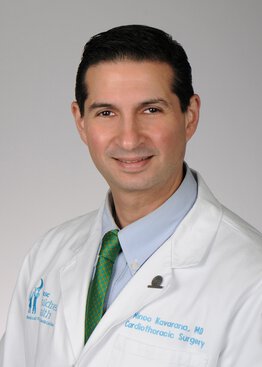
Minoo Naozer Kavarana, M.D., FACS
Minoo Kavarana, M.D., is a pediatric cardiothoracic surgeon who joined the department in 2010. In 2023, he was appointed the inaugural division chief of the newly created Division of Cardiothoracic Surgery in the Department of Surgery. Dr. Kavarana also serves in MUSC Health as Co-Director, Pediatric and Congenital Heart Center, and is the Surgical Director of the Pediatric Heart Transplantation and Mechanical Support.
Dr. Kavarana's clinical expertise include neonatal and infant heart surgery, adult congenital heart surgery, heart and lung transplant and mechanical circulatory support. He graduated from medical school in India in 1994. Following this he received post-graduate training in general surgery at New York Medical College, where he spent a year at Columbia University, New York as a heart transplant and ventricular assist device post-doctorate fellow. He then received cardiothoracic surgery training at the Jewish Hospital, University of Louisville, Kentucky where they implanted the first implantable total artificial heart. During this time, he developed a deep clinical and research interest in pediatric cardiac disease, pediatric cardiac assist and thoracic organ transplantation. Following this he completed a congenital heart surgery fellowship at the University of Michigan in Ann Arbor with Dr. Edward L. Bove.
In 2010, Dr. Kavarana joined MUSC in the division of cardiothoracic surgery. Dr. Kavarana's clinical interests include neonatal and infant heart surgery, adult congenital heart surgery, heart and lung transplant and mechanical circulatory support.