Welcome
Welcome to the Lench Lab at the Medical University of South Carolina (MUSC).
Our Mission
Parkinson's disease doesn't just affect a brain — it affects the life of a person. At the Lench Lab, we search for new ways to help a spouse, parent, or grandparent regain the ability to live life to the fullest. To do this, we are advancing high-precision brain stimulation and brain imaging to develop treatments for Parkinson's disease that have a real-world impact on patients and their communities.
What We Do
Our lab studies the brain using two main sets of tools.
Brain stimulation (neuromodulation)
These techniques gently change brain activity to improve symptoms:
- Transcranial Magnetic Stimulation (TMS) — a non-invasive method that uses magnetic pulses, applied through a small paddle held near the scalp, to nudge brain activity. No surgery is involved.
- Deep Brain Stimulation (DBS) — a surgical treatment in which thin wires placed in the brain deliver gentle electrical pulses to reduce movement symptoms.
- Transcutaneous auricular Vagus Nerve Stimulation (taVNS) — a non-invasive approach that delivers mild electrical signals through small electrodes placed on the skin just in front of and behind the ear (over the mastoid bone, the bony area behind the ear). It is not a clip worn on the ear.
Brain imaging (neuroimaging)
These techniques let us take detailed pictures of the brain and watch how it works:
- Functional MRI (fMRI) — shows which brain areas are active and how different regions communicate.
- Diffusion MRI (dMRI) — maps the brain's wiring, or the connections between regions.
- Electroencephalography (EEG) — records the brain's electrical activity using sensors placed on the scalp.
Why This Matters
We look for signals in brain images that help explain why symptoms differ from person to person, and that predict who is most likely to benefit from a given therapy. By mapping the key brain
networks involved, we aim to create individualized treatments that better target the wide range of symptoms this condition causes.
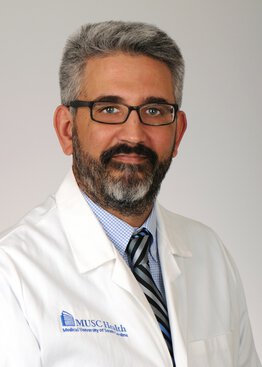
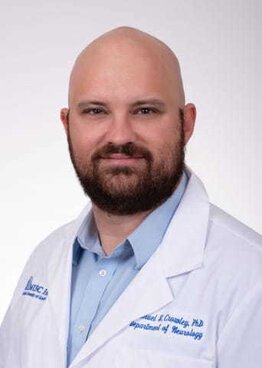
The Lench Lab is led by Dr. Daniel Lench and works closely with colleagues across several departments including Neurology, Psychiatry, and Gastroenterology. This interdisciplinary approach bringsmany perspectives together to drive research and innovation.
Join a Study
We are currently recruiting people with Parkinson's disease, as well as healthy volunteers, for several studies. These studies explore topics such as thinking and memory changes related to DBS, low motivation (apathy), and walking difficulty.
If you are interested in taking part, please visit our Study Participation page or contact Emily Laramie at laramie@musc.edu or 843-792-3873.