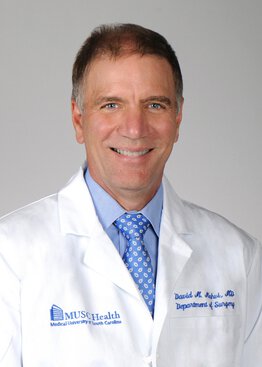
David Mahvi, M.D., is the MUSC Department of Surgery Vice Chair of Faculty Development and a surgical oncologist and innovator. He joined the faculty of MUSC in July 2016 as Professor of Surgery, chief division of oncologic and endocrine surgery, and chief of the oncology integrated center of clinical excellence (ICCE). Dr. Mahvi is a surgical oncologist.
Prior to his recruitment to MUSC Dr. Mahvi was the James R. Hines Professor of Surgery, chief division of gastrointestinal and oncologic surgery, and vice chair for clinical affairs Northwestern University Feinberg School of Medicine. He served also as President of Northwestern Medical Group. Before joining Northwestern, Dr. Mahvi was on the faculty of the University of Wisconsin-Madison ultimately as Chief of Surgical Oncology and Director of the General Surgery Residency Program. He led a research laboratory in collaboration with the University of Wisconsin School of Engineering.
Dr. Mahvi's research interests have focused on the development of new biomedical devices in the treatment of liver cancer - he is a national and international authority in the field of hepatobiliary cancer, and has previously developed, manufactured, and performed clinical trials of novel biologics. He is Founder and Director of the MUSC Department of Surgery Human Centered Design Team, part of the Harvey and Marcia Schiller Surgical Innovation Center.
The American Board of Surgery (ABS), the national certifying body for surgeons elected Dr. Mahvi as Chair for 2014 through 2015. During his tenure, he developed national policy on the education and management of the surgical workforce. Dr. Mahvi joined the ABS in 2007 as a representative of the Society for Surgery of the Alimentary Tract (SSAT), where he also served as President.
A native of Oklahoma, Dr. Mahvi completed his undergraduate work in microbiology and pre-medicine at the University of Oklahoma and went on to obtain his M.D. at the Medical University of South Carolina. He then served his residency and completed a research fellowship in immunology at Duke University Medical Center.