

Meet the Director and AI Team
Arman Kilic, M.D., Director of the Harvey and Marcia Schiller Surgical Innovation Center, is an internationally recognized expert on AI.
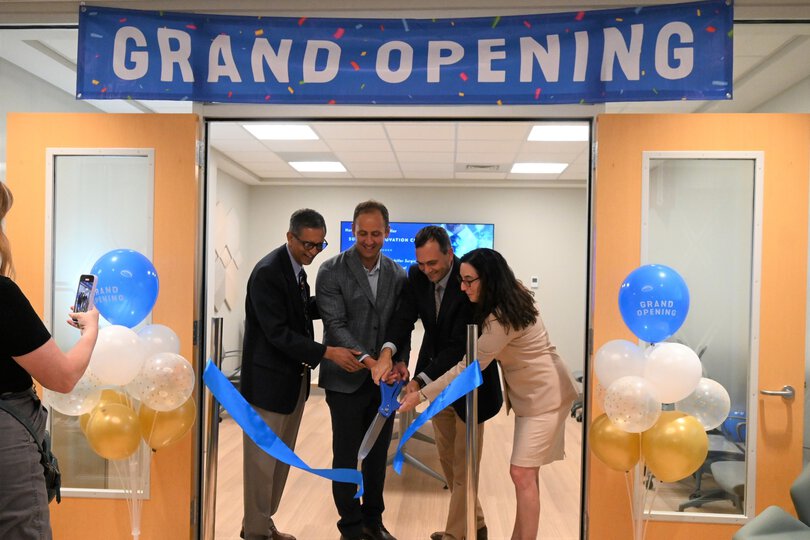
The Harvey and Marcia Schiller Surgical Innovation Center is a dedicated center to improve patient outcomes and healthcare efficiencies through surgical innovation.
The center includes three pillars:
Having these pillars in one centralized location and in close physical proximity allows for internal collaboration, streamlining of projects, and shared resources and expertise. Our goal is to improve patient care by developing AI predictive models and conduct outcomes research to support clinical decision-making.
The center has achieved several milestones: There has been rapid and exponential interest from all levels of medicine and data science to join the center.
In 2024 & 2025, the Department of Surgery held a Surgical Innovation Awards Competition. Four research teams were each awarded $25000 through the utilization of the expertise and computing services provided in the AI pillar of the Surgical Innovation Center. The Harvey and Marcia Schiller Surgical Innovation Center is proud to support the second annual innovation competition, with three awards being funded.
Arman Kilic, M.D., Director of the Harvey and Marcia Schiller Surgical Innovation Center, is an internationally recognized expert on AI.
MUSC Health Hereditary Cancer Clinic Research Group
The Cardiac Surgery Research Group conducts AI ML and NLP research
Current Projects in AI
SORIN fosters the development, testing and implementation of innovative therapeutic and health services interventions
The Human Centered Design Program serves to educate how to better design products for healthcare
Meet our clinical scientists
Our vision is for the center to serve as an incubator, centralizing and facilitating collaboration between clinical experts, Artificial Intelligence (AI) / Machine Learning (ML) experts, software engineers, clinical trialists, and innovation teams. This centralized center streamlines the process of advancing data science and translating these advancements to academic funding and the dissemination of commercial products that can immediately impact patient care and healthcare delivery.
A major focus of the center is in harnessing the massive quantities of healthcare data to develop predictive models that can be used for individualized patient care and for supporting clinical decision-making. We will also focus on developing algorithms that can accurately and in an automated fashion interpret imaging studies and use AI/ML and natural language processing to accurately and rapidly extract data from the electronic health record.
The impact will be to facilitate the creation of both personalized treatment plans and usable and innovative products that make healthcare better and more efficient. It will transform how surgery is performed, improve clinical care, and decrease costs for patients in South Carolina and across the United States.
The center is made possible through a generous gift from sports executive and retired U.S. Air Force Brigadier General Harvey Schiller and his wife, Marcia, who have committed to donating $1 million to establish the Harvey and Marcia Schiller Surgical Innovation Center.
In January 2024, with the support from our benevolent donors, department leadership, and the College of Medicine, the Department of Surgery held a Surgical Innovation Awards Competition. Four research teams were each awarded $25,000 through the utilization of the expertise and computing services provided in the AI pillar of the Surgical Innovation Center.
“Within our department, we had interest from surgical faculty in every division and received 13 exceptionally innovative scientific proposals during the inaugural Harvey and Marcia Schiller Surgical Innovation Center Award Competition,” said Arman Kilic, M.D. “We are grateful for the Schiller’s support, which allowed us to award three projects and through funding from the College of Medicine, we were able to award one more research team than initially planned.”
Good Planning for Better Scanning: Evaluation of Pediatric Blunt Abdominal Trauma - Pediatric surgeon Christian Streck, M.D.
Dr. Streck’s research aims to develop a machine learning model to predict which pediatric trauma patients are at low risk for complications, with the potential to improve the current model to avoid unnecessary CT scans nationally in this population.
Progress Update: Developed a Novel Clinical Decision Rule with State-of-the-Art Performance.
Publication: Submitted to Pediatric Trama Society Meeting. Frederick A, Wright A, Del Gaizo J, Streck C. A multicenter analysis of a two-tier triage system for serious injuries, morbidity and mortality in pediatric patients following blunt trauma. [submitted abstract]. Pediatric Trauma Society Annual Meeting.
Incidence of Thoracic Aortic Aneurysms and Neurogenic Hypertension in PTSD Patients --Jeffrey Jones, Ph.D., Sanford Zeigler, M.D. and Heather Holman, M.D., Ph.D. candidate
The cardiothoracic research team’s project aims to identify biomarkers or neurogenic hypertension and explore the role of social determinants of health in cardiovascular disease progression, with the goal to potentially delay thoracic aortic aneurysm progression in patients with neuropsychiatric disorders.
Progress Update: Found suggestive links between rupture likelihood and PTSD. Used as preliminary data for following VA Merit grant: Title: Stress-Induced Hypertension and Its Role in Accelerating Vascular Pathologies: Investigating the Impact of PTSD on ECM Remodeling and Aortic Health.
Rescuing non-responders after bariatric surgery in an adolescent and young adult population - Pediatric bariatric surgeon Aaron Lesher, M.D., MSCR
Dr. Lesher’s research is a computational project that uses existing EMR resources to generate an EARLY warning algorithm that identifies poor responders to weight loss surgery in the postoperative period (between 3-12 months0 with the ultimate goal to identify which mHealth interventions are most effective and appropriate for young individuals.
Progress Update: Used AI to access physician performance on psychological notes in predicting adolescent weight loss.
Publication: Frederick A*, Del Gaizo J*, Wright A*, Lesher A. Predicting weight loss after bariatric surgery in an adolescent and young adult (AYA) population using machine learning and natural language processing [accepted abstract, June 2025]. ASMBS, National Harbor, MD.Utility of Visceral Adiposity on Abdominal CT for Prediction of Bariatric Surgery Outcomes - Adult bariatric surgeon Mary Kate Bryant, M.D. MSCR
Progress Update: We developed algorithms to assign weight loss trajectory from historical record and developed semi-automated algorithms to extract visceral adipose tissue. With Next Steps:
Promising preliminary results on 1 and 2.
Leveraging Artificial Intelligence to Streamline the Shared Decision-Making Process for Patients with Stage I Lung Cancer - Kate Engelhardt, M.D., MS
Using Large Language Model Chatbots to make germline cancer genetics information available to patients and providers - Kevin Hughes, M.D.
Intelligent Decision Support for Modernizing the Organ Donation Process - Kannan Samy, M.D.